
Multiculturality is not a goal: it’s a starting point. Interculturality is where collaboration becomes transformational.
In today’s globalized workplace, diversity is everywhere. Companies proudly display flags, celebrate cultural holidays, and hire talent from around the world. But having people from different cultural backgrounds in the same space — physical or virtual — does not automatically translate into inclusion, collaboration, or high performance.
Let’s get something clear:
Multiculturality simply means that diversity is present. People of different origins coexist, often without significant interaction or mutual influence. Interculturality, in contrast, means that diversity is activated — people interact meaningfully, learn from one another, challenge assumptions, and adapt together. Interculturality is a dynamic process, not a static state.
The question is not whether companies are multicultural — most are, especially in international markets. The question is: how do we make the leap to becoming intercultural?
Why the distinction matters
Multicultural teams can remain fragmented, with people working in parallel without truly understanding or trusting each other. In such environments, communication tends to be neutralized, rituals are simplified, and cultural differences are often overlooked. As highlighted by Accem, multiculturality tends to result in mere coexistence, where multiple cultures share a space but do not intersect. Interculturality, instead, requires deliberate interaction. It demands the construction of bridges, the negotiation of meanings, and the co-creation of shared cultural norms.
Common challenges in intercultural interaction include clashing communication styles — such as direct versus indirect approaches — that may cause friction or confusion. Perceptual filters and unconscious biases can distort how messages are received and interpreted, reinforcing stereotypes. Teams may experience the formation of subgroups based on shared cultural background, which can lead to exclusion or isolation of others. And most critically, deeply embedded assumptions about “how things should be done” often block mutual learning, making it harder for teams to reach their full collaborative potential.
Intercultural teams make room for different ways of doing, being, and relating. They are not just diverse — they are transformed by their diversity. They recognize invisible power dynamics and address them. They build a “third space” — a space that is neither yours nor mine, but ours, co-created through dialogue and mutual learning.

What interculturality brings to the organization
According to AFS Intercultura and multiple organizational studies, intercultural competence is a combination of knowledge, skills, and attitudes that are not innate but can be developed over time. This view challenges the deterministic idea that only “naturally open” individuals can thrive in diverse contexts. On the contrary, the ability to interact effectively across cultures is trainable.
Interculturality brings with it a tangible set of organizational benefits. It improves collective problem-solving, enhances creativity, and facilitates innovation. Research shows that intercultural teams generate up to 35% more innovative ideas, provided they have support to navigate complexity. Moreover, interculturality contributes to higher engagement, lower turnover, and greater psychological safety. In client-facing teams, it enables better understanding of diverse markets. Studies like those from McKinsey and Harvard Business Review reinforce this by showing that diverse teams outperform their less diverse peers by 33–35% in terms of financial results and performance. Similarly, organizations with cultural and ethnic diversity have a 36% higher likelihood of exceeding their competitors in profitability, demonstrating that intercultural competence is not only socially valuable but also economically strategic.
One of the most widely recognized and research-supported benefits of interculturality in organizations is its positive impact on reputation and ethical positioning. Cultural diversity strengthens the company’s image as an ethical, inclusive, and socially responsible actor. It builds trust with stakeholders — clients, investors, partners, and society at large — and contributes to a more transparent and engaged brand identity. According to institutions such as Fundación Diversidad, El País, and Escuela de Emprendedores, promoting intercultural practices in the workplace aligns with the UNESCO Sustainable Development Goals (SDGs) and reinforces the company’s commitment to human rights, equity, and global citizenship.
But perhaps most importantly, it reshapes how people work together — it deepens trust, enriches communication, and unlocks previously untapped potential.
Moving beyond coexistence: what doesn’t work
One of the most common mistakes in corporate diversity strategies is to treat multiculturality as a goal. Companies often celebrate cultural holidays, share ethnic food in team events, or translate their intranet into several languages. These gestures, while well-intentioned, rarely touch the deeper layers of culture — those that influence decision-making, leadership, conflict, time, or trust.
Carlos Martín Pérez, in his thesis on implementing interculturality in organizations, argues that we need to go beyond symbolic gestures and invest in deeper processes: capacity-building, feedback systems, inclusive leadership development, and protocols for managing conflict that integrate cultural variability.
Without this work, diversity may become a source of tension rather than richness. Multicultural teams can suffer from miscommunication, stereotyping, and even exclusion, all masked under a superficial layer of harmony.

What are the challenges?
Organizations are not neutral containers. They embody norms, values, expectations, often invisible, that reflect the dominant culture. These norms define what is seen as “professional,” “efficient,” or “appropriate.” In multicultural settings, these standards may exclude other ways of contributing.
The journey toward interculturality is not linear. It includes confronting bias, navigating uncertainty, and being willing to redesign processes. It requires unlearning: a difficult but necessary part of creating a new culture that reflects all, not just the majority.
Common obstacles include:
One of the key practices for transforming a team from multicultural to intercultural is assigning interdependent tasks from the beginning (rather than mechanical ones), avoiding cultural minority-majority configurations, fostering a shared purpose while respecting cultural identities, and evaluating both the processes and results of the team (not of individuals).
From multiculturality to interculturality: five paradigm shifts
How do we get there? Practices and tools
One of the most effective methods cited in our research is the use of experiential tools like the “five-senses intercultural board”. Developed by Intrama, this tool invites teams to explore culture through the five senses, not just intellectually, but physically and emotionally. It allows for deep storytelling and awareness of the norms we carry with us and the ones we unconsciously impose.
Another crucial intervention is team coaching. A skilled coach can hold the space for difficult conversations, facilitate mutual understanding, and support the emergence of new norms. The coach does not impose content but enables process helping teams create their own answers through guided reflection and experimentation.
Learning journeys should be progressive and hybrid, combining in-person sessions, self-paced reflection, role plays, simulations, and real-time feedback. The AFS model provides a strong reference: start from awareness, move to understanding, and land in action. It emphasizes the development of what it calls “intercultural superpowers”: competencies such as empathy, self-awareness, effective communication, open-mindedness, and adaptability. These abilities are not acquired overnight; they require continuous reflection, practical experiences, and structured accompaniment to become truly embedded in behavior.
Equally compelling is AFS’s emphasis on cultivating a mindset of social innovation within these journeys. By encouraging participants to create impact-driven projects aligned with their values and the UN Sustainable Development Goals (SDGs), organizations foster not only intercultural skills but also a deeper sense of internal motivation and cultural alignment. This approach positions intercultural competence not just as a relational skill, but as a driver of ethical action and innovation within the company.
As an additional tool for building intercultural teams, organizations can incorporate structured role-play activities that simulate cultural misunderstandings and allow participants to apply metacommunication in seeking intercultural solutions. Digital technologies and interactive platforms can also be used to create real-world practice scenarios and support blended learning, making skill-building more relevant and continuous.

Rethinking leadership
Interculturality demands a shift in leadership: not only in style but in purpose. Leaders must abandon the myth of neutrality. They are not “above” culture: they are part of it. Their role is to make culture visible, question norms, and enable their teams to do the same.
This includes:
Leadership becomes less about control and more about facilitation. It’s not about having the right answer: it’s about creating the right conditions.
Transversal insights on culture and behavior
Culture, as emphasized across our sources, is not limited to nationality. It includes gender, age, profession, generation, region, and even life experience. Every individual carries multiple cultural identities and navigates between them fluidly. The same person can behave differently in a family context versus a corporate boardroom.
To visualize culture, the iceberg metaphor is a powerful tool: only a small fraction of cultural elements are visible: such as food, clothing, or language. Most of what determines behavior lies beneath: values, taboos, assumptions, logics of power, notions of time, and ideas about what is fair or respectful.
This hidden dimension is also where biases operate. Stereotypes, cognitive shortcuts, and unconscious assumptions shape how we see others and how we interpret their actions. Learning to detect and challenge these patterns is essential for any intercultural team.
Frameworks like those from Hofstede, Rosinski, and Erin Meyer help us navigate key cultural dimensions: linear versus flexible time, direct versus indirect communication, egalitarian versus hierarchical leadership, individual versus collective orientation.
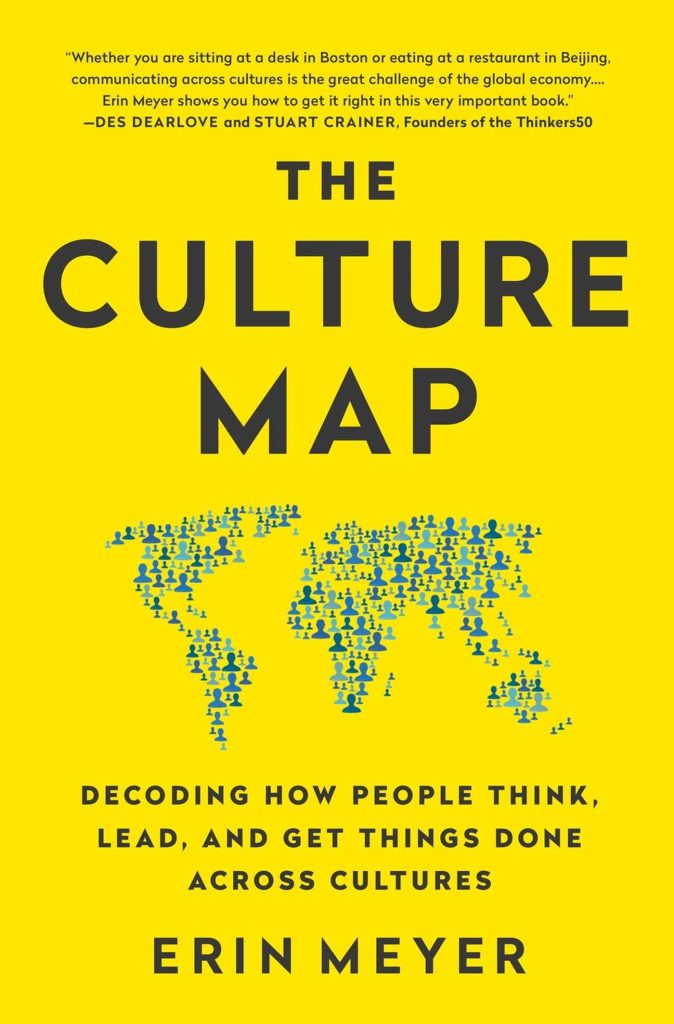
Among these, Erin Meyer’s “Culture Map” stands out for its practical application in global business. Her framework identifies eight cultural dimensions that significantly impact collaboration:
For instance, a French manager (high-context, confrontational) may misinterpret the behavior of a Japanese colleague (high-context, avoids confrontation) during feedback sessions. Similarly, an American team’s preference for direct communication might clash with the more diplomatic style of Brazilian partners. These tensions can be addressed through exercises like role-play or scenario-based reflection, where teams practice navigating such differences with metacommunication tools.
These models are starting points, not boxes. They should open dialogue, not close it.
Relevant business examples
Interculturality is not just theoretical; it plays out in very tangible ways within real companies. Learning from their experiences allows us to better understand what supports or obstructs the development of intercultural teams.
Novo Nordisk offers a powerful case of success. When facing communication gaps between its global headquarters and local subsidiaries, the company introduced intercultural facilitators who act as cultural bridges. These professionals do not simply translate language, but mediate values and expectations. The initiative succeeded because it relied on a flexible, multicultural, and relatively flat organizational structure, where relational authority was prioritized over hierarchical status. Messages were adapted to the cultural logic of each local context: not diluted, but reframed.
In contrast, Panasonic (formerly Matsushita) illustrates the risks of imposing monocultural norms. The company attempted to enforce Japanese managerial practices and values across all its international branches without modification. This led to disconnection, a lack of synergies, and a diminished sense of belonging among local employees. The top-down transmission of culture created resistance instead of alignment.
LEGO, on the other hand, demonstrates a hybrid and adaptive model. While holding on to a strong core of company values, it allowed national subsidiaries to shape those values through local interpretations. This approach enabled each team to “make the culture their own,” fostering innovation from within. By combining clarity at the center with flexibility at the edges, LEGO managed to build a cohesive yet culturally responsive organization.
These examples highlight that interculturality is not about abandoning values: it’s about expressing them through inclusive, locally attuned practices that allow all employees to thrive and contribute meaningfully.
From the inside out: organizations as change agents
Organizations are more than economic units: they are cultural ecosystems. They reproduce norms, shape identities, and influence society. Choosing interculturality means taking a stand: affirming that dialogue, equity, and mutual respect are not just desirable, but essential.
Workplaces can become laboratories of coexistence, where new forms of collaboration emerge. These forms not only serve internal objectives, but ripple outward, modelling what is possible in communities and societies at large.
The goal is not to erase difference: it is to work through it, with it, and because of it.
Final reflection
Multiculturality is a demographic fact. Interculturality is a deliberate practice.
It requires courage. It requires time. It requires guidance. But the payoff is worth it: a workplace where everyone contributes fully, grows continuously, and belongs authentically.
Yes, it is possible to move from multiculturality to interculturality.
And yes, it starts with us.
Let’s build that bridge. Together.
Would you like to bring this transformation to your team?
Schedule a free initial session to discover how to promote intercultural collaboration in your company.
To provide the best experiences, we use technologies such as cookies to store and/or access device information. Your consent to these technologies allows us to process data such as browsing behavior or unique identifiers on this site. Withholding or withdrawing consent may negatively affect certain features and functions.